
Signal-Based Outbound Framework: The Stack You Didn’t Know You Needed
The full signal-based outbound stack: what signal stacking is, how to set the framework up end to end, and the common mistakes that make it misfire.

Shaimaa Badawi
· 15 min read
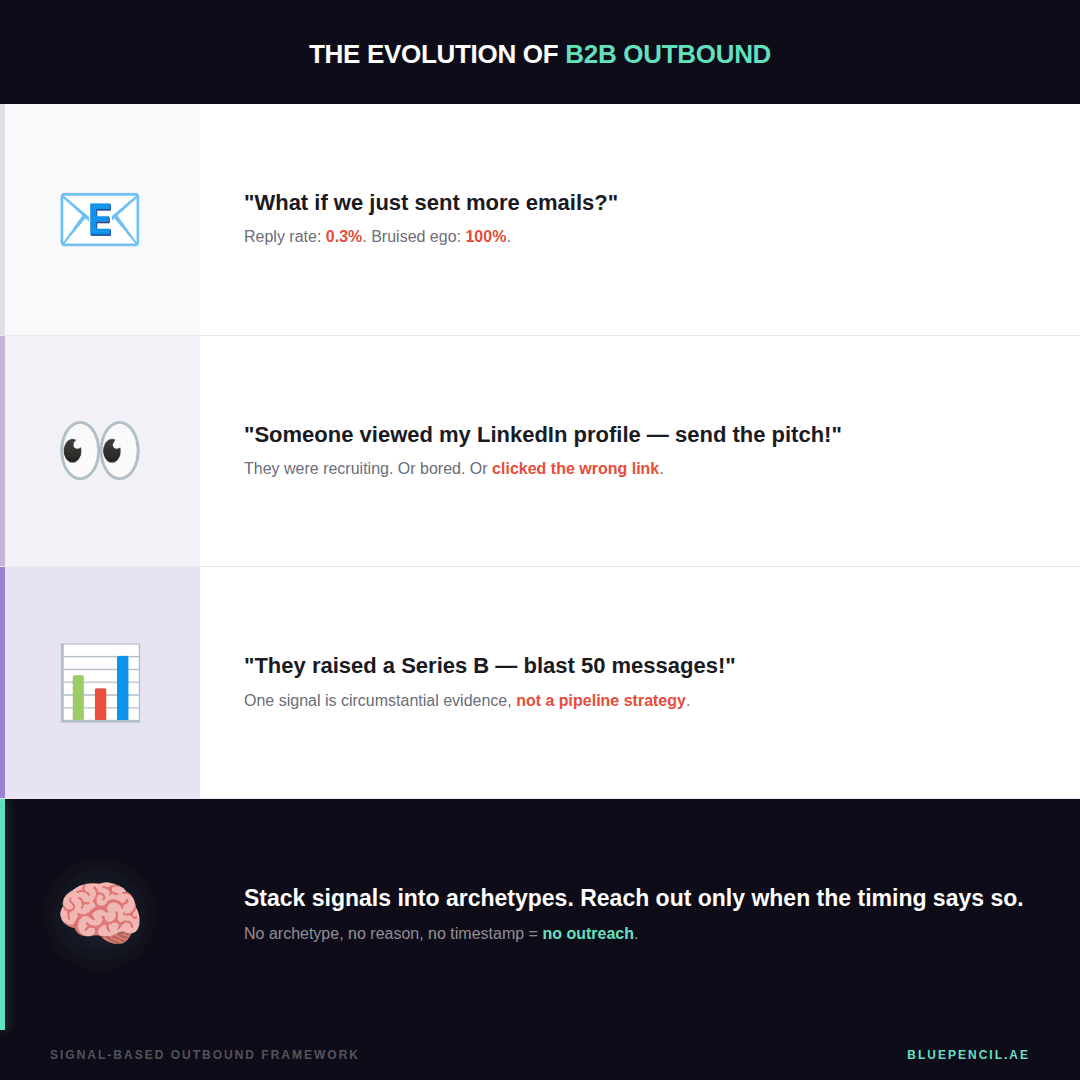
At some point, someone in B2B sales thought: “What if we just sent more emails?” And then someone else said “What if we sent even more?” And then we all collectively descended into the cold outbound arms race, where the prize was a 0.3% reply rate and a bruised ego.
We’ve all been there. Blasting thousands of messages to a list that was “pretty targeted,” hoping a handful would stick. The volume game feels productive. It’s not.
What actually works is reaching the right person, at the right company, at the exact moment they’re ready to have the conversation. Not six months before. Not six months after.
That’s what this signal-based outbound framework is about. And in this article, we’re going to show you how to pull it off.
When your outbound strategy has a character arc
What is a signal-based outbound framework?
The concept isn’t new. Signal-based outbound is a B2B GTM strategy that uses real-world behavioral and situational data, like job postings, funding rounds, LinkedIn activity, and website visits, to identify when a prospect might be ready for a conversation. Instead of cold-blasting everyone in your ICP, you focus on the people who are actually showing signs of buying intent.
Now, you’ve probably seen this approach before. People running outbound campaigns when a prospect visits their team’s LinkedIn profile or engages with a competitor’s post or visits their website. While these are good instincts, the execution is wrong.
Here’s the problem: one signal is not a strong enough indicator to say this prospect has HIGH intent. Someone visiting your LinkedIn profile could mean a hundred different things. They could be recruiting. They could be bored. They might have clicked the wrong link. One lone signal gives you a “maybe.” And “maybe” is not a pipeline strategy.
What makes this framework different from everything else out there is two things: the way we tier signals, and the way we stack them into archetypes. We’re not chasing any intent. We’re chasing HIGH intent. That distinction is everything. High intent doesn’t appear in a single data point. It shows up when the right combination of signals lines up at the same time. That’s the whole game, and that’s exactly what this framework is built to catch.
How does signal-based outbound improve sales processes?
1. Your sales team won’t waste their time
Listen, your sales team is already up to their eyeballs chasing targets and complaining about the quality of marketing leads. This high-intent signals approach ensures they spend most of their time on the most promising leads, not every lead they get their hands on. Imagine your marketing team delivering, every month, a batch of high-intent leads to sales. That’s the GTM dream.
2. Your messages will actually land
There’s a big difference between “Hi, I noticed you work at [Company]” and “Hey, I saw you just expanded your engineering team. Here’s how we helped a similar company do exactly what you’re building.” Signals give you the context to write the second version. And the second version is the one that gets replies.
3. Better conversations, better deals
When you reach out with context, like knowing their hiring trends, their leadership changes, or their public pain points, your outreach doesn’t sound like a pitch. It sounds like you’ve done your homework. That leads to better first conversations, and better first conversations lead to better close rates.
4. You stop looking like everyone else
Cold outreach is dying. Buyers are ignoring templated sequences at an industrial scale. The teams winning right now are the ones showing up with relevance by saying the right thing to the right person at the moment it actually matters. This framework is the systematic way to do exactly that, every single time.

Be smarter than Grand Master Oogway
What is signal stacking in B2B marketing?
Signal stacking is exactly what it sounds like: instead of looking at one signal and jumping to conclusions, you layer multiple signals on top of each other to build a much clearer picture of where a prospect actually sits on the “ready to buy” spectrum.
Think of it this way: a single signal is circumstantial evidence. Stacked signals are a conviction. One LinkedIn profile visit? Circumstantial. That same visit, combined with a job posting for a role that needs your solution, combined with a recent funding announcement? Now you’ve got something.
This is the core mechanic behind the whole framework. We don’t trigger outreach based on isolated actions. We wait until the signals stack into a clear, high-intent pattern, what we call an archetype. When an archetype fires, you reach out, not before. More on that in a moment.
How to set up a signal-based outbound framework
Step 1: Set up three signal tiers in Clay
Define and track three types of signals to indicate a prospect's level of engagement and intent. You’ll be able to categorize leads and prioritize outreach based on the prospect’s buying stage.
Tier 1: Build signals (proof of investment)
Tier 1 signals show that your prospects are actively building and investing. These are the "money plus people" signals that prove they are working toward growth or operational changes.
Examples of Tier 1 signals:
- Relevant job openings (indicating hiring for decision-maker roles)
- Relevant hires/promotions (e.g., hiring for a VP of Marketing)
- New partnerships or integrations (indicating a shift toward innovation)
- New tech detected (companies adopting relevant technologies)
- Relevant initiative launches (new business initiatives that require your solution)
- Headcount growth (companies expanding their teams)
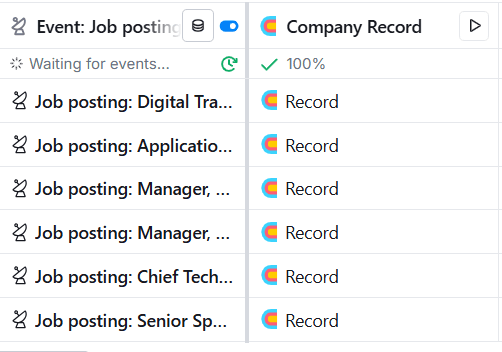
Job postings monitored in Clay as a Tier 1 build signal
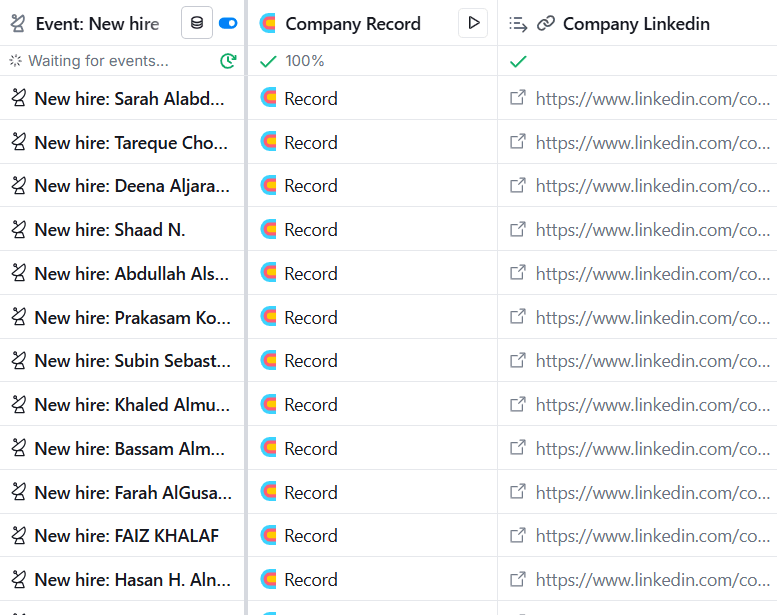
New hires tracked as a Tier 1 build signal
Tier 2: Forcing functions (urgency events)
Tier 2 signals are external events that create urgency for the prospect. These signals often indicate moments in time when a company needs to act quickly.
Examples of Tier 2 signals:
- Mergers and Acquisitions (M&A)
- IPO announcements
- Financing rounds (e.g., Series A or Series B)
- Office expansion (indicating business growth)
- Signing new clients (leading to increased demand for solutions)
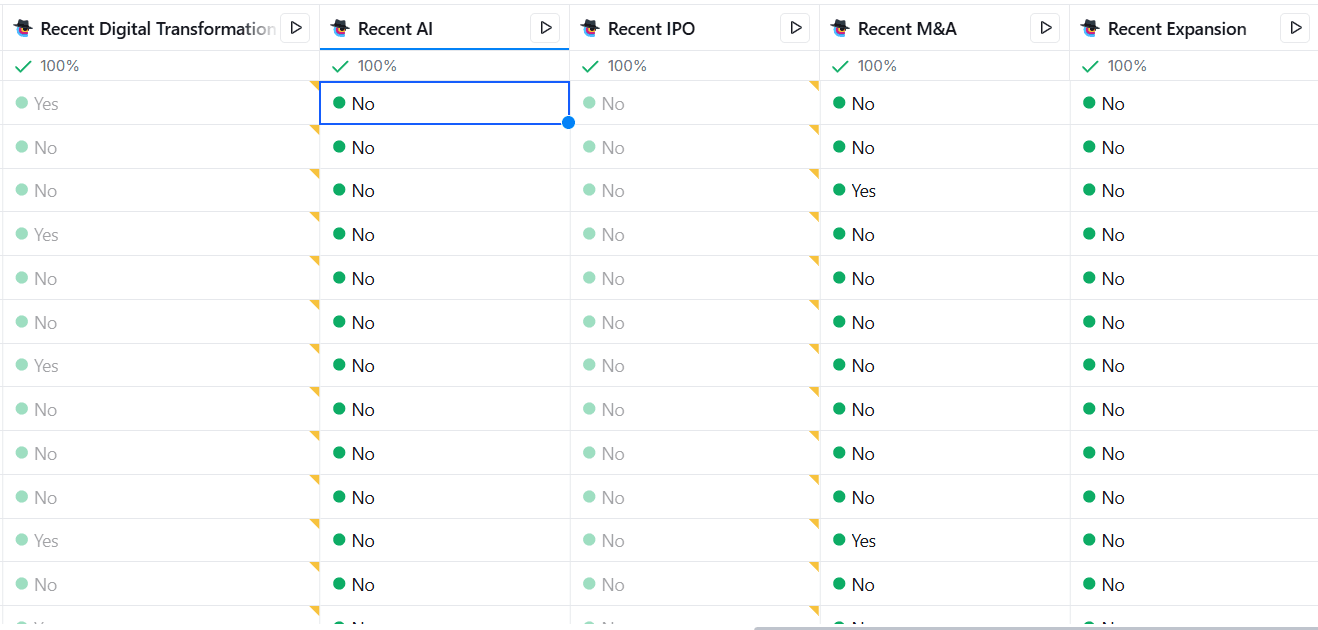
Company-level Tier 2 signal columns in Clay
Tier 3: Confirmation signals (intent validation)
Tier 3 signals help validate whether the prospect is ready to engage. These are behavioral signals that indicate interest or intent to purchase.
Subtypes of Tier 3 signals:
- Attention: Prospect visits your website or engages with your content on LinkedIn.
- Problem: Prospect attends a relevant event or posts about their pain points on LinkedIn.
- Ownership: A prospect changes their job to a relevant new company.
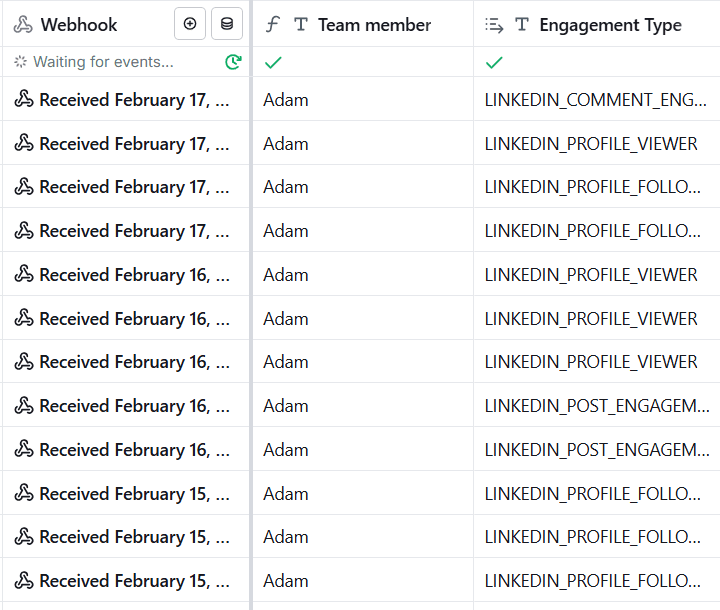
LinkedIn engagement signals flowing into Clay
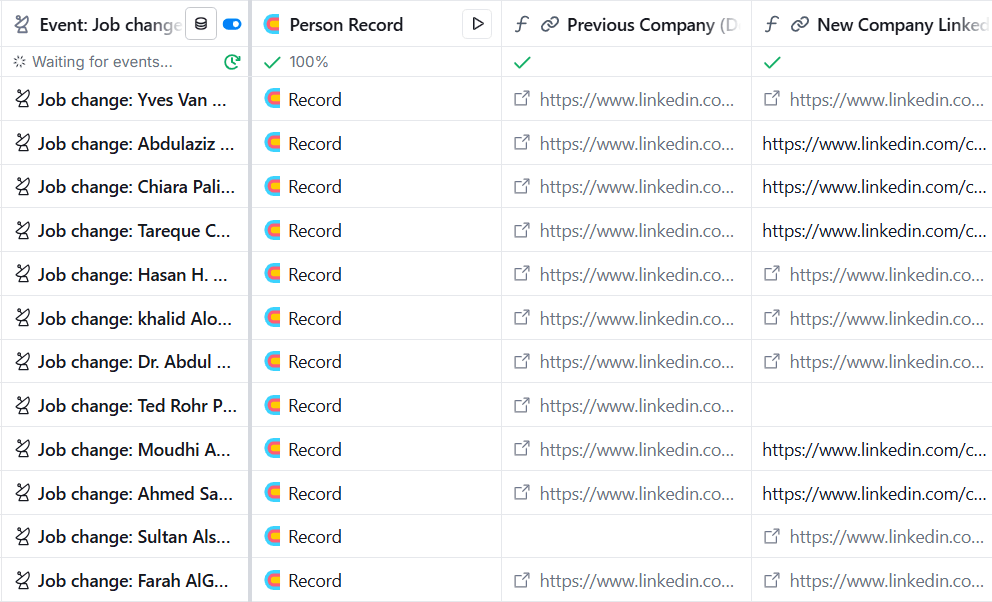
Tracking job changes as a Tier 3 ownership signal
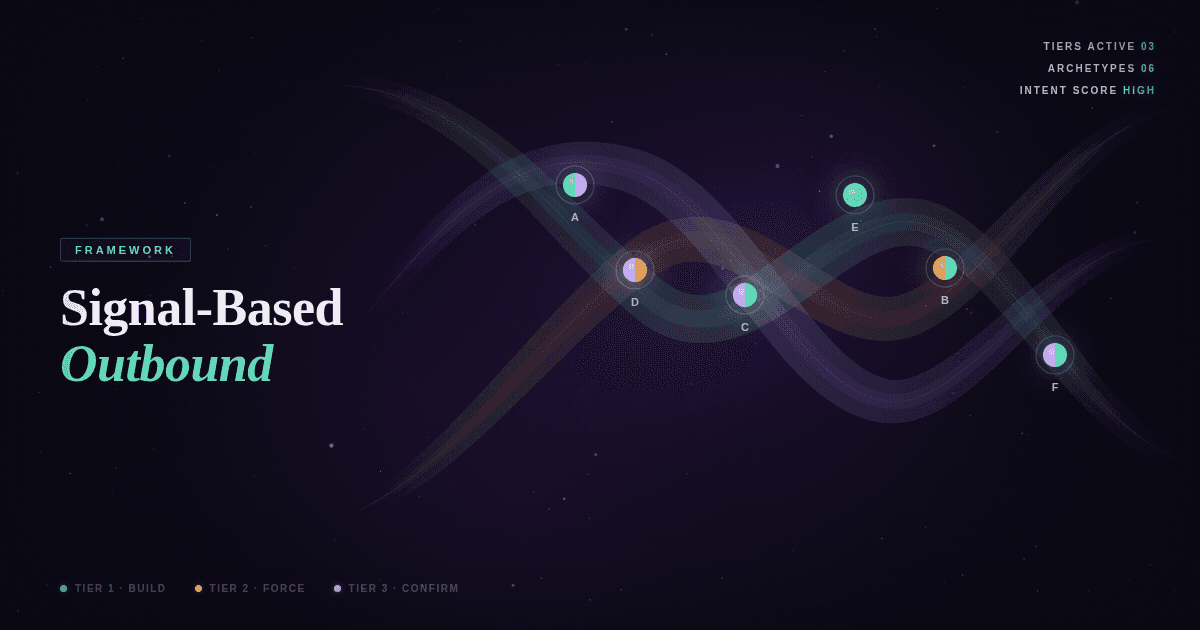
Step 2: Stack signals into six “reach out now” archetypes
Next, you’ll create six distinct archetypes that will help you decide when to reach out to prospects and how to tailor your messaging. These archetypes combine different signal tiers to give you a comprehensive understanding of when to make contact.

Archetype tables organized inside Clay
Archetype A: “Build + Confirm”
Tier 1 signals are all about building, like when your target account is hiring for some important decision-making roles. Maybe they’ve posted a bunch of SDR roles or are expanding their team in a way that screams, “We’re scaling up.” When a company is hiring for key positions, it’s a clear sign they’re investing in growth. So far, it’s all good. They’re building.
Now, here comes the Tier 3 (Attention) signal: someone from their team, a decision-maker or someone in the know, visits your pricing page. Now, this is important because they’re not just hiring. They’re actively looking at your solutions, which means they’re interested. So, we’re not just guessing here. They’ve given us a little clue, like a breadcrumb trail, saying, “Hey, I’m checking out your stuff.”
This is your window. Don’t wait for them to stumble across you through a Google ad or a competitor’s case study. You already have the context. Use it.
Archetype B: “Force + Build”
Tier 2 signals are those external forcing functions, the big events that create pressure for a company to act fast. Let’s say this company just raised Series B funding. They’ve got the cash, but now they’ve got the pressure to use it wisely and scale quickly.
Now, add in the Tier 1 signal. This company has also got multiple open engineering roles. So, they’re not just sitting on that money. They’re actively building their team to support all this new growth.
Picture this: a startup just closed a $15M Series B. By Wednesday morning the CEO is on calls with the board about where the money is going. The VP of Engineering has already posted four new job listings. The CMO is refreshing LinkedIn like it’s a morning ritual. They have capital, they have pressure, and they have absolutely zero patience for slow vendors.
That’s your cue. “We can help you scale fast” hits completely differently right now than it would six months ago when they were still in survival mode.
Archetype C: “Problem + Build”
Tier 3 (problem) signals are all about the prospect voicing their pain. Maybe a VP posts on LinkedIn about a major issue they’re having with data quality. It’s a big challenge for the whole company, but the important part is, they’re putting it out there for the world to see.
Now, you’ve got the Tier 1 signal on the other side: the company is hiring for a data engineer. So, it’s not just a passive post. They’re actively building their team to solve this exact problem. They’re already investing resources to fix what they’ve just publicly admitted is a challenge.
This is basically your prospect standing up in the middle of LinkedIn and saying “We have a problem!” You’re not cold outreach at this point. You’re a well-timed answer to a live question they’re already asking. The difference between being seen as helpful vs. spammy is almost entirely about timing, and this archetype hands you the timing on a plate.
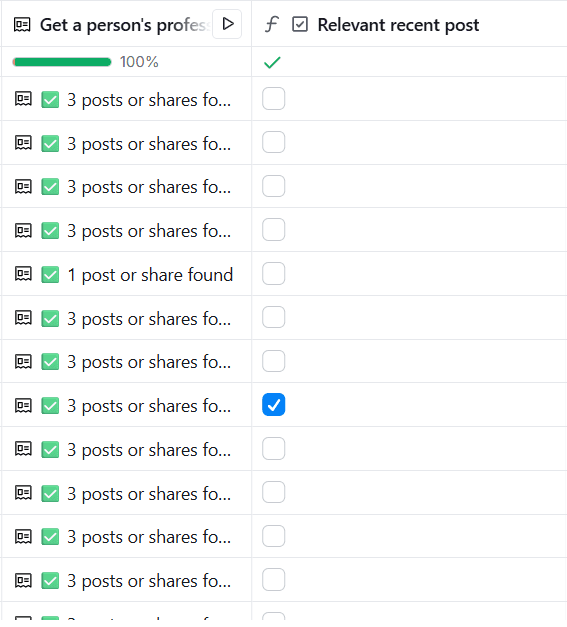
Checking for relevant recent posts as a Tier 3 signal
Archetype D: “New Leader Reset”
There’s a rule in B2B sales that everyone quietly knows but rarely talks about. New leaders clean house. Not out of spite, they just need to prove they have a vision, and the fastest way to do that is to reset the tools, the processes, and sometimes the team. The first 90 days is essentially open season on old vendor contracts.
Now imagine a new CRO joins from a company that already loved your product. This is a Tier 3 (ownership) signal. They’re not a cold prospect at all. They’re a warm champion looking for permission to bring their old playbook to a new place. Pair that signal with a Tier 1 or 2 signal. Say, someone lands a new leadership role and immediately announces a relevant initiative (Tier 1). You don’t have months to think about outreach. You have weeks. That’s the moment to step right in with your solution.
Archetype E: “Double Build”
One Tier 1 signal? Interesting. Maybe they’re exploring. Two independent Tier 1 signals? That’s a completely different conversation.
When you see a company hiring for DevOps roles while simultaneously launching a cloud migration initiative, you’re not looking at a company that’s “thinking about” change. You’re looking at one that’s already knee-deep in it. Get in front of them before a competitor does.
Archetype F: “Multi-Actor Proof”
Most outbound targets one person and hopes for the best. But B2B buying decisions, especially at enterprise level, don’t work like that.
Nobody is signing a six-figure contract because one VP liked your LinkedIn post. There’s a whole buying group involved, and the real conversations are happening in internal Slack channels and boardroom catch-ups you’re not invited to.
So, when you spot two VPs and a director all showing up at the same industry conference (Tier 3) while their company is making relevant hires in parallel (Tier 1 or 2), that’s not coincidence. That’s an internal buying conversation that’s already in motion.
This is the rarest archetype to catch. But when you do, this is the account you drop everything for. Personalize hard. It’s your chance to make the first move that counts.
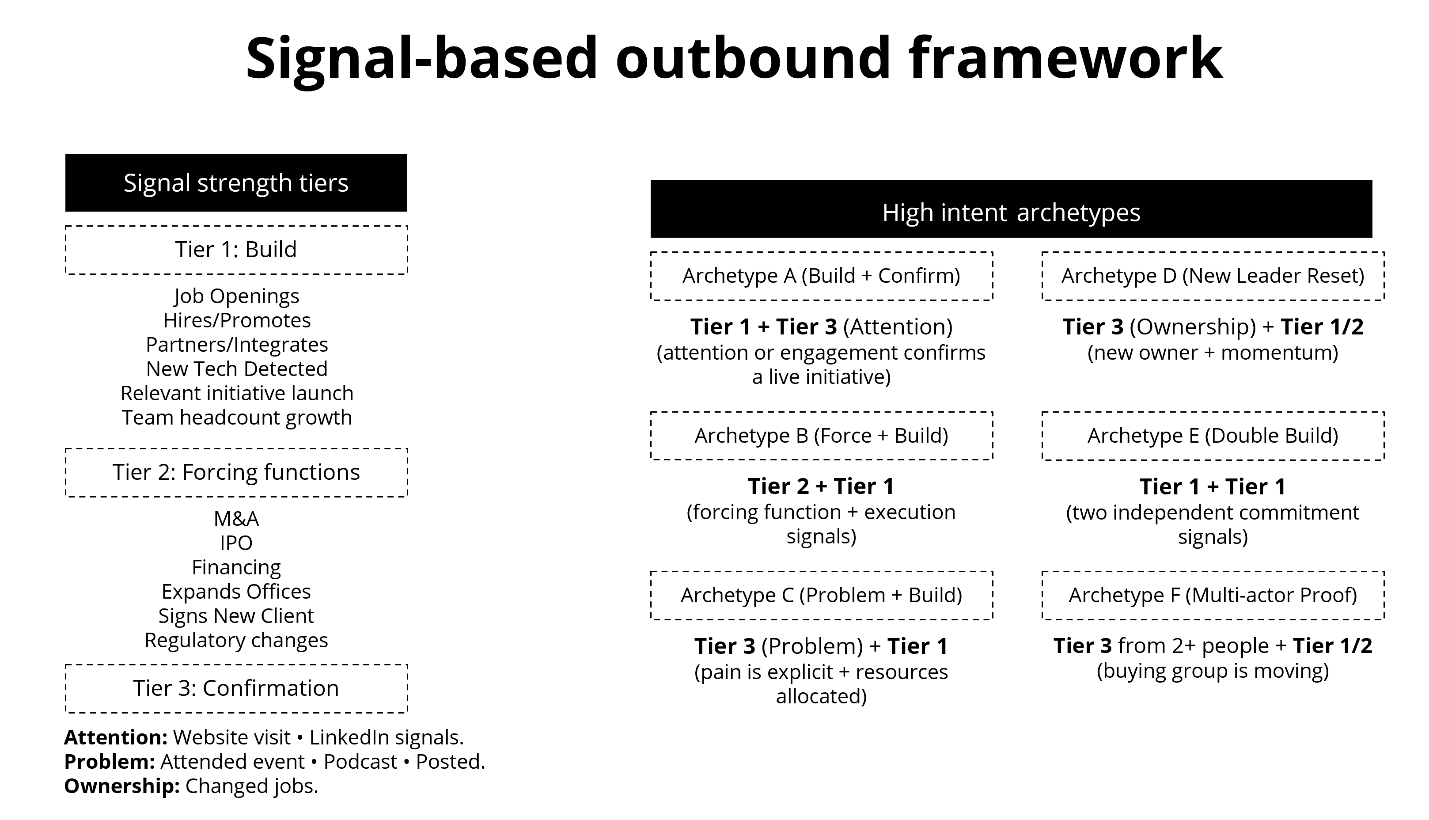
The complete signal-based outbound framework at a glance
Step 3: Turn archetypes into outbound lanes (where the magic actually happens)
Your archetypes tell you when to reach out. Your outbound lanes tell you what to say. Each archetype needs its own angle, its own proof, and its own ask. One message doesn’t fit all.
For each archetype, nail down three things:
- What gets said: The specific hook that connects your solution to what’s happening at their company right now. Not your value prop but their situation.
- What gets shown: The social proof that makes the message land (e.g., case studies, testimonials, or product demos).
- What the CTA is: The next step for the prospect (e.g., scheduling a demo, signing up for a trial, or having a discovery call).
Here’s what that looks like in practice:
Archetype A (Build + Confirm):
- Angle: “Noticed you’re scaling your team fast. Looks like you’re hiring for [X role]. We helped [Similar Company] do the same thing without the usual growing pains. Worth a quick look?”
- Proof: A case study from a company at a similar growth stage that used your solution during a scale-up phase. Ideally, same industry, same pain.
- CTA: “Worth a 15-minute call this week?” That’s it. Keep it short. They’re busy scaling.
Step 4: Automate the system so it runs without you babysitting it
A system that requires someone to manually check signals every day is not a system. It’s a chore. Here’s how you make it run on its own:
- Signal refreshing: Stale signals are worse than no signals. They make you look out of touch. Set Clay to refresh bi-weekly at minimum. Monthly if your ICP moves slowly. You want to be working with what’s true today, not three months ago.
- Automatic tagging: When a prospect hits the right signal combination, tag them automatically in Clay and assign them to the relevant archetype.
- Trigger outreach: Outreach only fires when an archetype threshold is met. Not when someone on the team has a hunch or when you haven’t sent anything in a while.
The one rule that makes all of this work:
- No archetype, no reason, no timestamp = no outreach. If you can’t answer “why this person, why now” in one sentence, the lead goes back in the pool. This is the rule that separates a signal-based system from an expensive list with extra steps.
What are common mistakes in signal-based outbound?
1. Blasting the same message to every signal like it’s 2015
Mistake: You built this whole system to know exactly why you’re reaching out: the specific tier combination, the archetype, and the moment. Then the message goes out and it reads like a template from a cold email course. That’s leaving all the signal work on the table.
Solution: Personalize the outreach for each signal archetype (e.g., “Build + Confirm” should have different messaging than “Force + Build”).
2. Running outbound on vibes
Mistake: Someone spots a signal, thinks it looks promising, and fires off a message. Someone else misses the exact same signal entirely. There’s no tagging, no threshold, and no record of what happened. It’s just chaos with a LinkedIn account.
Solution: The rule is simple. If it doesn’t have an archetype, a reason, and a timestamp, it doesn’t get touched. Build that into Clay, automate the tagging, and make sure the whole team is working from the same playbook.
3. Hoarding signals without action
Mistake: Some teams get addicted to the data. They set up 40 signal columns in Clay, pat themselves on the back, and then nothing happens. Signals pile up. Nobody acts. You’ve built an incredibly expensive spreadsheet.
Solution: Signals only matter if they lead somewhere. Stack them into the six archetypes from this framework. When a threshold is hit, that triggers outreach, not a meeting to discuss the data.
4. Chasing events, not timing
Mistake: A company raises a Series B. You fire off 50 outreach messages the next morning. The problem? That event by itself doesn’t tell you if they’re actually in buying mode for your solution. One signal, no matter how flashy, is still just one signal.
Solution: Layer the event signal with others. That Series B hit? Wait to see if hiring picks up for relevant roles or a VP also posts about a pain you solve. This is now archetype territory.
5. Setting up the system once and ghosting it
Mistake: Signals go stale. A company that was hiring aggressively three months ago might have frozen headcount last week. If you’re still reaching out based on old data, you’re missing the moment.
Solution: Schedule regular signal refreshes in Clay bi-weekly or monthly. Outdated signals lead to awkward outreach. Fresh signals lead to conversations that feel like you’re always one step ahead.
Final words: Timing + relevance over volume
Here’s the uncomfortable truth: most outbound fails not because the product is bad or the reps aren’t trying. It fails because the timing is wrong, the message is generic, and nobody really knows why they’re reaching out in the first place.
This framework fixes all three. You only reach out when the signals say it’s time. You only message with context that’s specific to what’s happening at that account right now. And you always know exactly why you’re showing up.
Do it right, and you won't be doing outreach anymore. You’re showing up at the exact moment a prospect is already in motion.
It’s not a volume game. It’s a timing + relevance game. And now you know how to play it.

Shaimaa Badawi
Shaimaa Badawi is a Paid Media Specialist at Blue Pencil, helping companies in the GCC grow their sales pipeline through data-driven B2B strategies. She also writes practical, high-intent content that teaches teams how to identify the right prospects, optimize outreach, and generate meaningful results. Shaimaa has experience in content strategy and creating insights that help marketers and sales leaders close more deals with fewer wasted touches.