Why B2B Brands in the GCC Are Losing Deals Before the First Sales Call
Most GCC B2B deals are lost before the first sales call. Here are the five signals buyers read in 90 seconds, plus a 30-minute audit to fix what they see.

Meryll Rocha
· 12 min read

You just got ghosted. Again.
After retracing each interaction, you’re still wondering where you went wrong. You did everything by the book: your outreach was sharp, you hit every pain point, and your pitch checked every single box they asked for.
But the second you asked for the meeting? Total radio silence.
It’s a tough pill to swallow, but the pitch wasn't the problem. The problem was they didn’t trust you. Not yet, anyway.
In the GCC, business moves at the speed of trust. Before a buyer in Dubai or Riyadh ever agrees to a call, they've already completed a quiet, invisible audit of your entire digital presence such as your LinkedIn, your website, your founder profile, recent content, and mutual connections. It takes about 90 seconds. And if you don't pass, you never even find out you failed.

Me seeing the “Seen” receipt on a cold email for the 100th time.
This article is your blueprint for fixing that with specific tools, proven frameworks, and trusted approaches we use with clients across the region.
The 90-Second Verdict (And Why You're Probably Failing It)
Let's talk about something most GTM teams completely ignore: the Dark Funnel.
The Dark Funnel is all the research, deliberation, and opinion-forming that happens before a buyer ever fills in a form or takes a meeting. In the GCC, it is particularly powerful and unforgiving. It exists in WhatsApp groups, in LinkedIn feeds, and in conversations between trusted peers. You can't track it, but you can influence it by showing up consistently, over time, as a credible voice in the market.
If your brand feels stale, no amount of aggressive outbound will compensate for what's happening in those invisible spaces.
This brings us to one of the most important strategic frameworks for B2B companies operating in the region.
In-Market vs. Out-Market: Why Your GTM Needs to Be Elastic
At any given time, roughly 5% of your total addressable market is actively in buying mode. These are the "in-market" buyers: they have a budget, a problem, a timeline, and they're evaluating options right now.
The other 95%? They're out-market. Not uninterested, just not ready. They're tracking the space, building opinions, watching who the credible players are. In 6 months, or 18 months, some of them will flip into the 5%. And when they do, they won't start their search from scratch. They'll go to whoever they've already built familiarity with.
Most B2B companies in the GCC build their entire GTM motion around the 5%. Outbound sequences, paid ads, aggressive SDR activity, all targeted at people who are ready to buy now. That's fine for short-term pipelines, but it's a disaster for long-term growth, especially in a trust-led market.
An elastic GTM system serves both segments simultaneously:
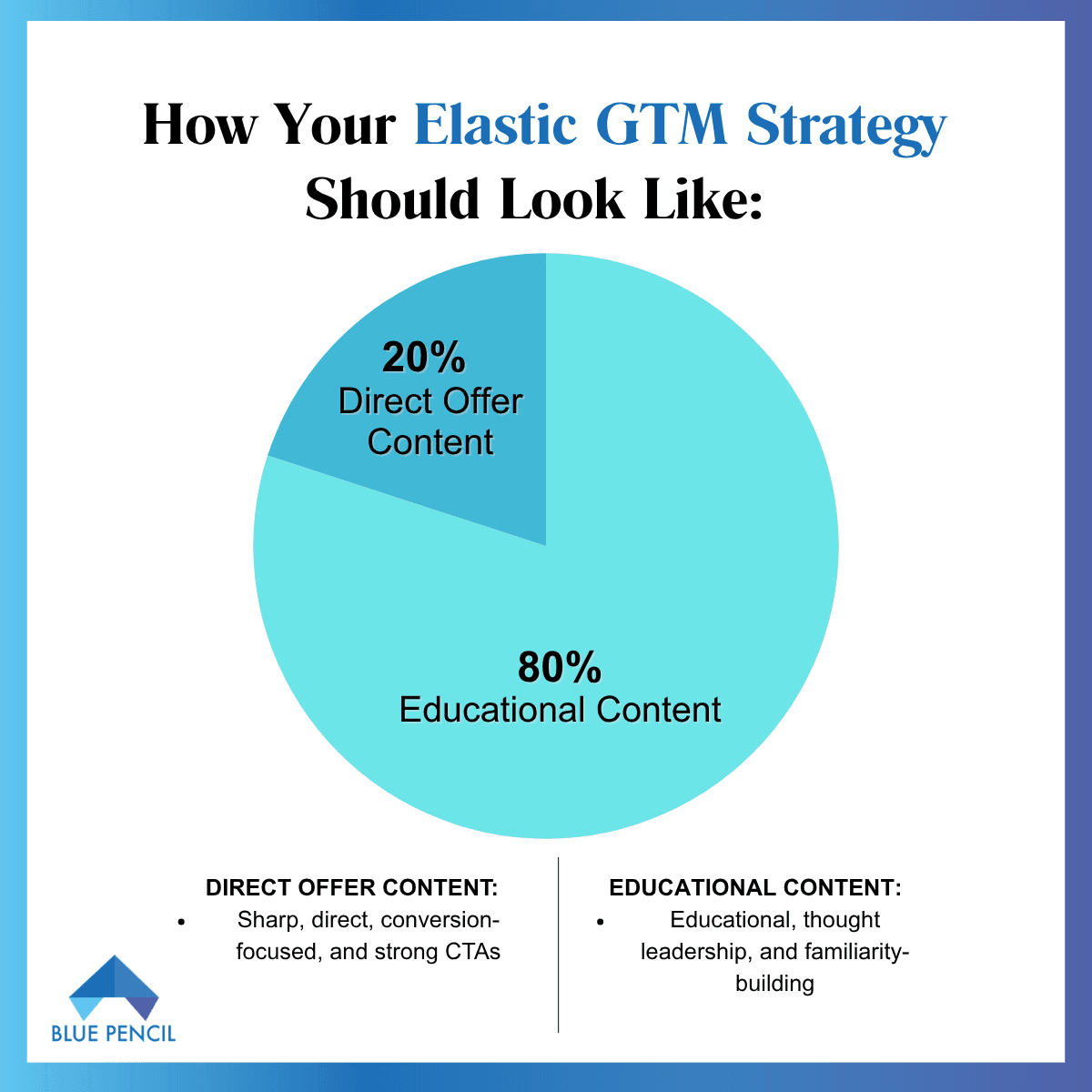
- For out-market buyers: education, thought leadership, familiarity-building found in content that makes you memorable long before they need you.
- For in-market buyers: sharp, direct, conversion-focused messaging seen in demos, case studies, strong CTAs, sales sequences.
At Blue Pencil, we recommend an 80% education, 20% direct offer content ratio. The education content is doing slow, compounding work on 95% of the market while the direct offer content converts the remaining 5%. This isn't just intuition, LinkedIn's own algorithm data confirms it: "teach-before-you-pitch" posts generate 3x higher CTR than straight promotional content, and case studies with real metrics outperform sales copy by 5.2x.
When you have the structure down, thinking of content should be easy as pie.
The 5 Signals You're Failing Your Next Call
Before we get to solutions, let's diagnose the problem. Most SaaS companies operating in the GCC are quietly leaking credibility through one or more of these five failure points.
1. Your LinkedIn looks like a ghost town
If your last post was a generic "Happy New Year" graphic from 14 months ago, you look like you've gone out of business. In the GCC, personal thought leadership is the new business card. When a prospect searches for your founder or your sales lead, they want to see someone with a perspective, a voice, a point of view on the industry. If they find a grey silhouette and two posts from 2022, the trust evaporates.
2. Your website speaks to everyone (so it speaks to no one)
"Global enterprise solutions for modern businesses." We've all seen it. If your copy doesn't reference a single regional pain point, regulation, or case studies from the region, then GCC buyers assume you're copy-pasting a US strategy onto them. They're right to be suspicious.
3. Your content section is a digital museum
An outdated blog with the last post dated 2022 is an active red flag. If you aren't consistently publishing insights, how should a buyer believe you're a credible guide through their problem?
4. Your social proof doesn't look like them
A wall of Silicon Valley logos is fine for closing deals in San Francisco. In Dubai, it's a mild warning sign. If there's not a single recognizable GCC brand, regional case study, or Middle Eastern testimonial in your proof stack, buyers quietly wonder: "Do they actually understand our market?"
5. Your outreach and your website are telling different stories
If your pitch says "cutting-edge AI automation" but your website looks like it was built in 2015 and never touched since, the cognitive dissonance kills the conversation. Every touchpoint must tell the same story at the same quality level.
If you counted two or more of these, it's time for a proper audit.

Audit everything, Jon Snow.
The 30-Minute Pre-Sales Brand Audit
Run through this before your next outbound push:
- Open your company LinkedIn page as if you're a buyer. Would you follow you?
- Does your website mention GCC, UAE, or KSA by name?
- Search your CEO or founder on LinkedIn. Do they have a voice, or are they invisible?
- Pull up your last three outbound emails. Do they match the tone and quality of your website?
- Look at your case studies. Is there a single regional reference?
If two or more of those made you wince, keep reading.
Building Familiarity Before the First Call: The Thought Leadership Playbook
Building trust and closing deals in the GCC is not done in a single meeting, but through repeated, low-stakes exposure over time. Every time a prospect sees your founder share a sharp insight on LinkedIn, your company posts a genuinely useful piece of content, or a mutual connection mentions your name, you get better trust and reputation by the time your prospects are ready to close.
This is the role of personal thought leadership. And it is massively underinvested by most B2B companies in the region.
Here's how to build it systematically.
Step 1: Build the Founder's (and Team's) LinkedIn Presence
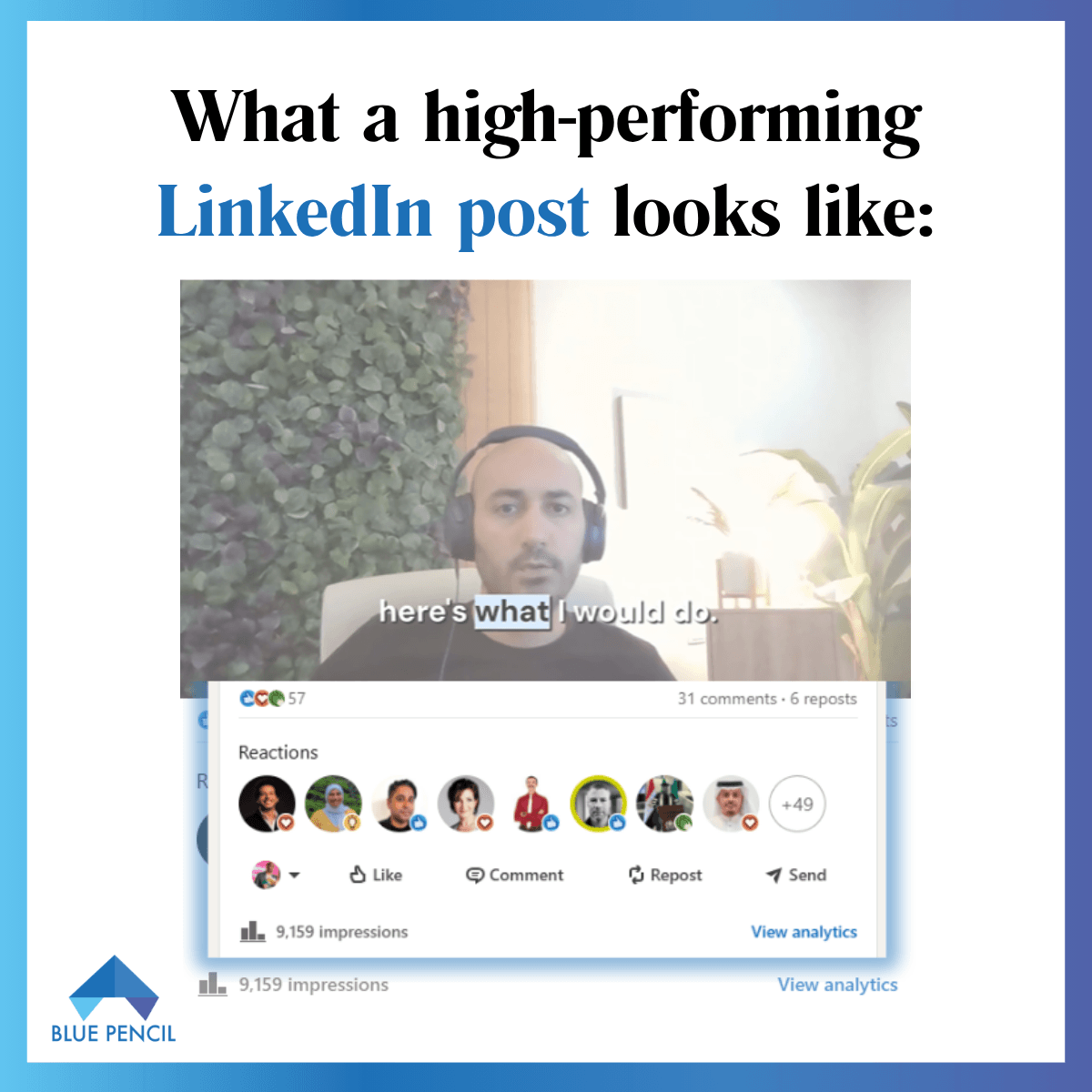
LinkedIn reach in the GCC is disproportionately powerful compared to most other markets. Decision-makers are active and engagement rates are strong. The competition lies in creating "good content,” which means showing up consistently with clear, relevant insights puts you in the top 10% almost immediately.
The numbers make the case plainly. Personal posts make up 69% of all organic feed distribution on LinkedIn, while company pages account for just 1.6%.
In practical terms: your founder's personal profile has roughly 43 times more organic reach than your brand page. Posts shared by employees also generate 168% more impressions than the same post published directly from the company page. The algorithm has decided that people trust people, not logos.
Practically, this means:
- It’s ideal for the founder to post 3 to 4 times per week with a genuine point of view, not recycled news or "I'm excited to announce," but actual opinions on what's happening in the market.
- The sales team should be active and visible, commenting on prospects' posts, sharing relevant content, building familiarity before any cold message lands.
- Content themes should be mapped to the problems your buyers are navigating right now.
When your GTM strategy actually lands.
Step 2: Use AI for Ideation and Research, But Keep the Voice Human
One of the biggest blockers to consistent LinkedIn activity is the blank page problem. What do I write about? What's relevant this week? How do I turn a client conversation into a post?
In Blue Pencil, we use Gumloop to streamline this process by building automated research, ideation, and post generation workflows that help our team generate content at scale, while having a writer monitor the process to maintain a human voice.

Time to reach your (work)flow state.
The workflow typically works like this: pull relevant industry news and signals, run through an ideation prompt, output a list of post angles and hooks, then the writer picks, personalizes, and publishes. It takes what used to be 45 minutes of staring at a blank screen and turns it into a 10-minute editing job.
One critical caveat: don't let the AI write the final post. LinkedIn's algorithm now identifies and suppresses AI-generated promotional content as AI copy sees up to 60% less reach due to low semantic diversity. As of October 2025, AI tools touch an estimated 44% of all LinkedIn content (up from 21% in February), and the platform has responded accordingly.
Remember: AI handles the research and structure, while the human handles the opinion and voice. That combination is what makes the content feel authentic rather than generated.
Step 3: Run Video Content to Build Real Familiarity
Text posts build familiarity, while video builds connection. There's a reason the most trusted voices in any B2B market are the ones you've seen and heard, not just read.
We run a 1:1 video interview series with founders, operators, and decision-makers across the GCC. Short-form, direct, no fluff. The format works because it does two things simultaneously: it positions our brand as a connector and curator in the market, and it gives the guest a piece of content they're happy to share with their own network, seamlessly extending our reach to their audience.
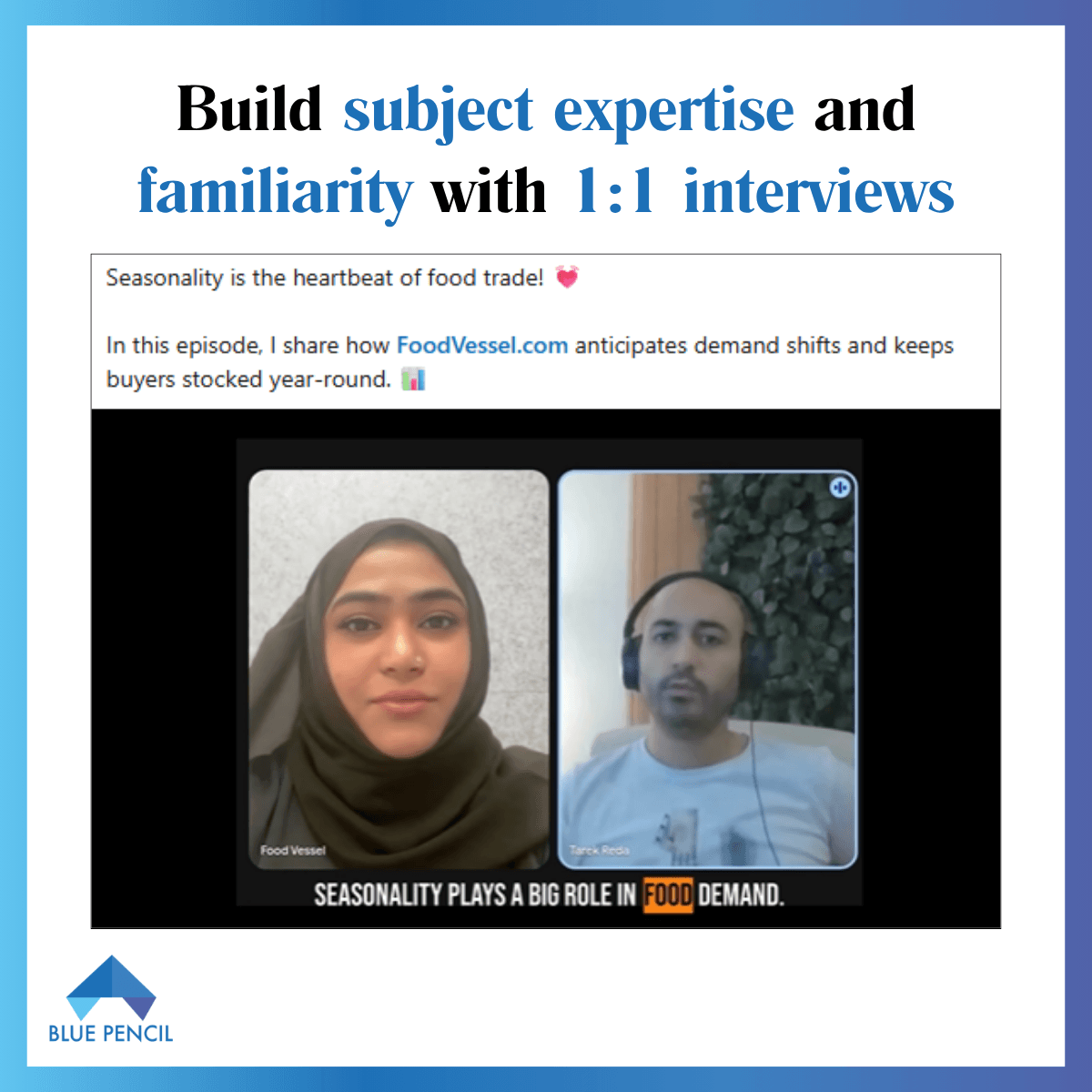
Prepare to be a friendly face.
Even if you're not running interviews, the principle applies: get on camera. A 60-second founder video sharing a genuine observation about the market will do more for your brand than five polished text posts. One tip worth noting: manually adding captions (not auto-generated ones) improves engagement by 28%. It takes five extra minutes and almost nobody does it.
Step 4: Invest in Visual Posts That Stop the Scroll
The GCC LinkedIn feed is noisy, and text alone no longer cuts through. Custom visual assets such as data visualizations, frameworks, quote cards, process diagrams don't just look better, they perform better.
We create designed assets for posts that feel consistent with our brand and make the content easier to consume and share. The numbers support the investment: posts that include human imagery outperform abstract visuals by 40 to 60%. Carousel documents dominate for saves and reposts, where documents account for 32.4% of all reposts on the platform, the single highest format. In a market where most companies are posting raw text, visual differentiation compounds over time.
Check out our sample infographics for a few clients and see how they use imagery to make their point.
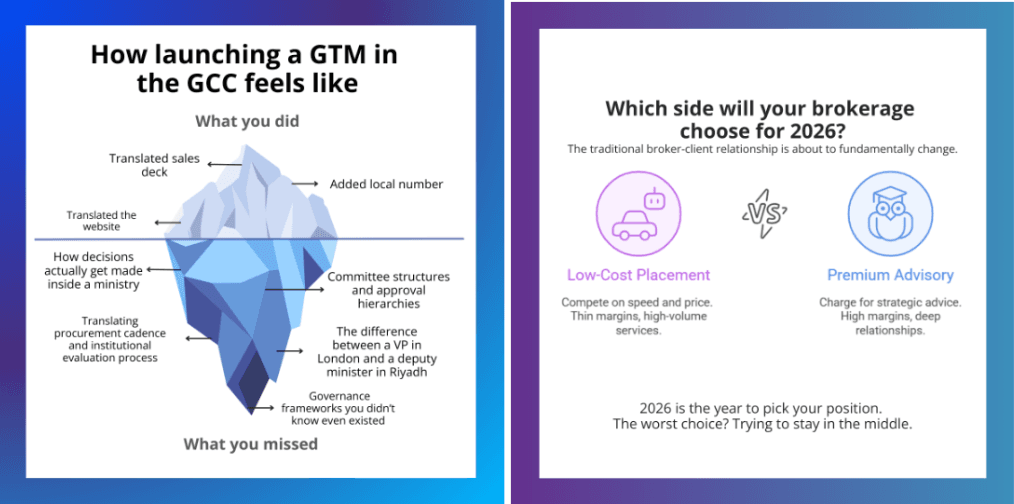
Sample visuals that get the point across.
Warming Prospects Before You Message Them: The Extrovert Play
Here's a scenario most SDRs will recognize: you've identified a strong prospect, you know they're a good fit, but you've had zero interaction with them. The cold message lands in their inbox, gets a quick read, and disappears. No reply.
That’s where it usually goes wrong, by the time you message them, your prospect should already know you exist.
We use Extrovert to systematically warm up target accounts before any outreach begins. The tool lets you track what your prospects are posting on LinkedIn, surface the right moments to engage authentically, and build a pattern of genuine interaction such as likes, thoughtful comments, and shares so that when your message lands, they already know your name.
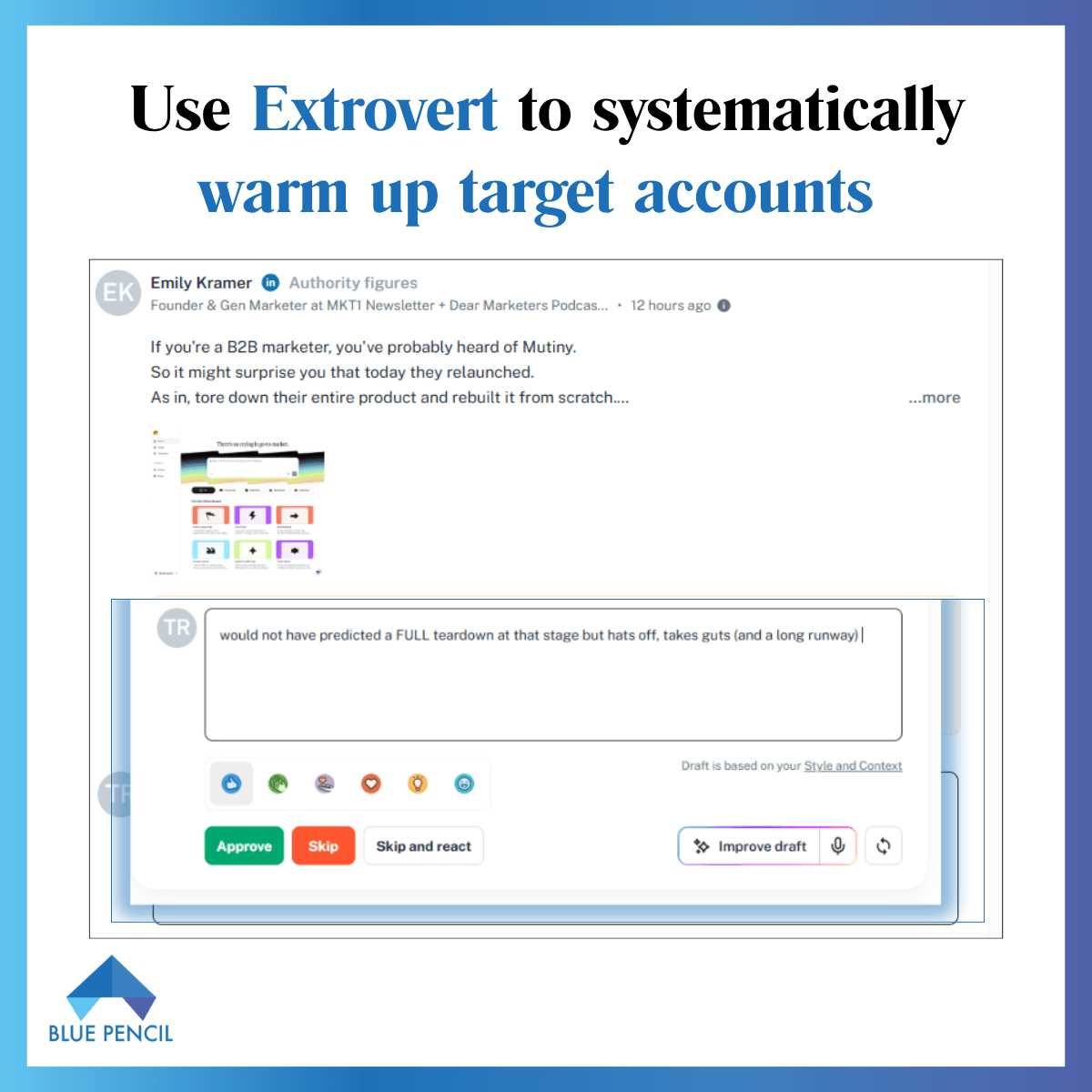
Not in the mood to talk? Extrovert has you covered.
This isn't about gaming the algorithm. It's about doing at scale what good salespeople have always done naturally: pay attention to the people you want to build relationships with, engage with what they care about, and earn familiarity before asking for anything.
In the GCC, where trust is a prerequisite for every deal, showing up in someone's notifications as a genuine, engaged presence for three weeks before you message them is the difference between a warm conversation and a cold void.
Putting It Together: The Full Pre-Sale Brand System
Here's what the full system looks like when it's running:
- Elastic GTM content: 80% education for the 95% out-market, 20% conversion content for the 5% in-market. Both running simultaneously, always.
- Founder and team LinkedIn presence: Consistent, opinionated, human-voiced content published 3 to 4 times per week. Built with AI-assisted ideation (Gumloop) but written and owned by real people.
- Video content: Short-form interviews and founder videos that build connection, not just familiarity.
- Visual post assets: Designed graphics that stop the scroll and reinforce brand quality.
- Prospect warming via Extrovert: Systematic engagement with target accounts before any cold outreach, so you're never a stranger when you reach out.
- Website and messaging alignment: Every touchpoint — website, outreach, social — tells the same story at the same quality level, with specific GCC relevance built in.
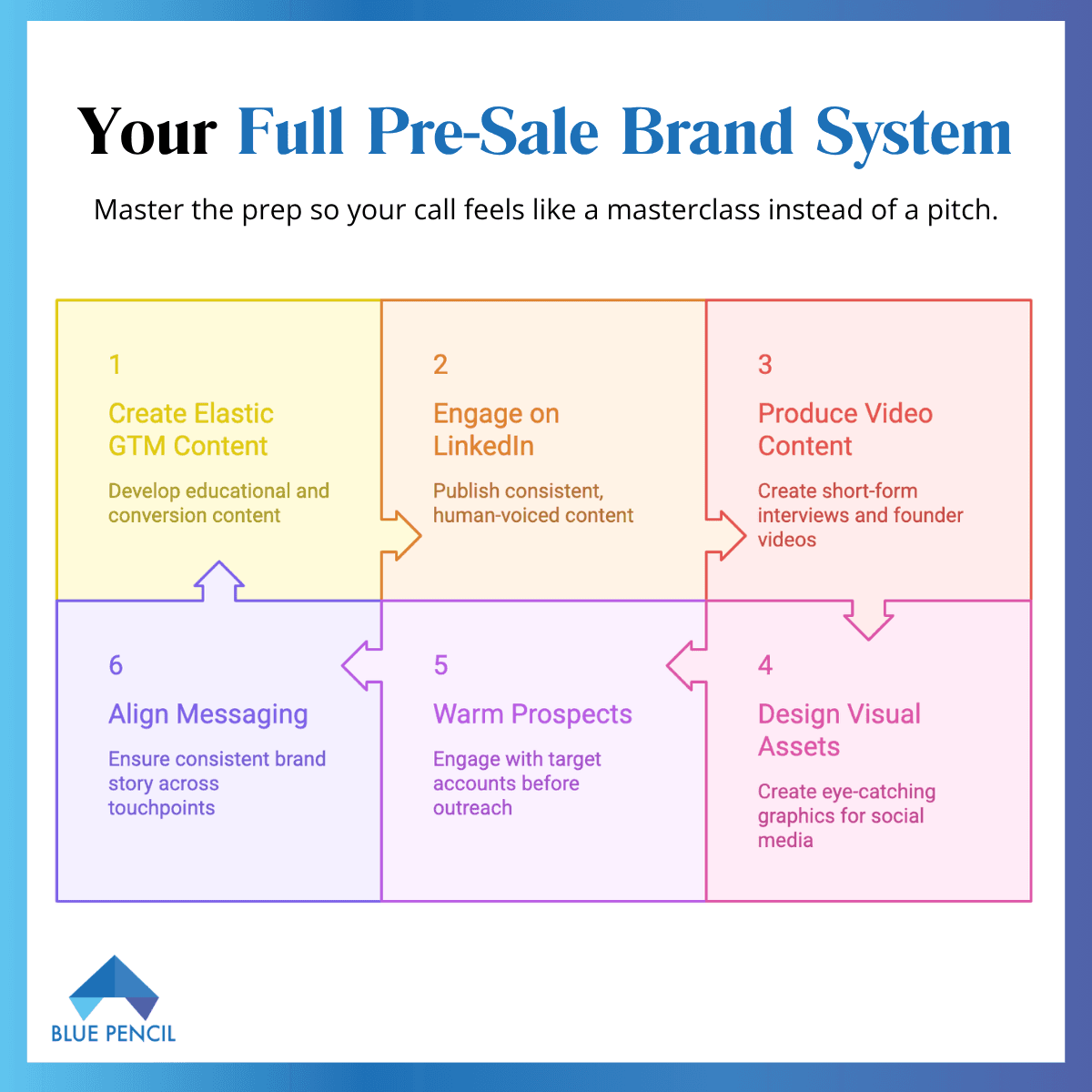
Pre-sale? More like pre-solved.
The Trust Gap Is a GTM Problem
The GCC is one of the fastest-growing B2B markets in the world. The opportunity is real, but the companies winning here aren't necessarily the ones with the best product. They're the ones that understood early that in this market, trust is the product.
The deals you're losing before the first call aren't due to a weak pitch. They're lost because you haven't done the slow, unglamorous work of building presence, familiarity, and credibility in the spaces where your buyers are watching.
Start with the audit, identify where you need credibility, then build the system.
Need help improving any of these areas? That's exactly what we do. Shoot us a message.

Meryll Rocha
Meryll Rocha is a B2B copywriter dedicated to high-impact storytelling. With a journalism background, she brings a fresh perspective to GTM strategies for businesses of all sizes. When offline, she’s likely playing with her dogs or online shopping.