Signal-Based Outbound for GCC Tech Companies: The 2026 Playbook
A practical playbook for GCC tech companies: which buying signals actually matter, how to build the cadence around them, and the mistakes that stall most regional outbound programmes.

Shaimaa Badawi
· 15 min read

Every B2B sales team in the GCC has tried it. Buy a list, load it into your sequencer, and craft that tired first line: “I noticed your company is growing fast.” Blast 2,000 people. Get eight replies. Five of them: “Please remove me from your list.”
The GCC market is small. Your VP spammed on LinkedIn is in a WhatsApp group with 20 other VPs. Your brand reputation is already bruised. Your SDR hasn’t even finished the first sequence.
What actually works is reaching the right person, at the right company, at the exact moment they're ready to have the conversation. That's signal-based outbound. In the GCC when you’re going after mid-market/enterprise, it's not a nice upgrade. It's the only approach that makes sense when your total market fits on a spreadsheet.

When "scaling" just means louder.
What is signal-based outbound and why should GCC tech companies care?
Signal-based outbound is basically outbound with a brain. You only reach out to prospects when they’re actually showing signs they might buy, like hiring for a role your product supports, closing a funding round, or lurking on your LinkedIn posts.
Forget blasting your whole ICP and hoping someone bites. Instead, you focus on the tiny slice of the market that’s actually moving right now.
Picture this: you sell a marketing automation tool for B2B tech companies in the UAE and Saudi Arabia. You open LinkedIn Sales Navigator, filter your ICP, and boom 1,800 results.
That’s not a segment. That’s the entire market. Send a generic cold sequence to all of them, and congratulations, you just torched your sender reputation. There’s no second list. The list is the market.
In the US, a failed outbound campaign is a minor setback. You slice another 50,000 accounts and try again. But in the GCC when you’re going after mid-market/enterprise, you just burned your entire pipeline.
And here’s the kicker: the GCC B2B world is ridiculously small. The CRO you pitched badly at a Dubai SaaS company? He was at GITEX last week chatting with the CMO of the fintech you’re targeting next month. One lazy outreach sequence can quietly slam doors at companies you haven’t even emailed yet.
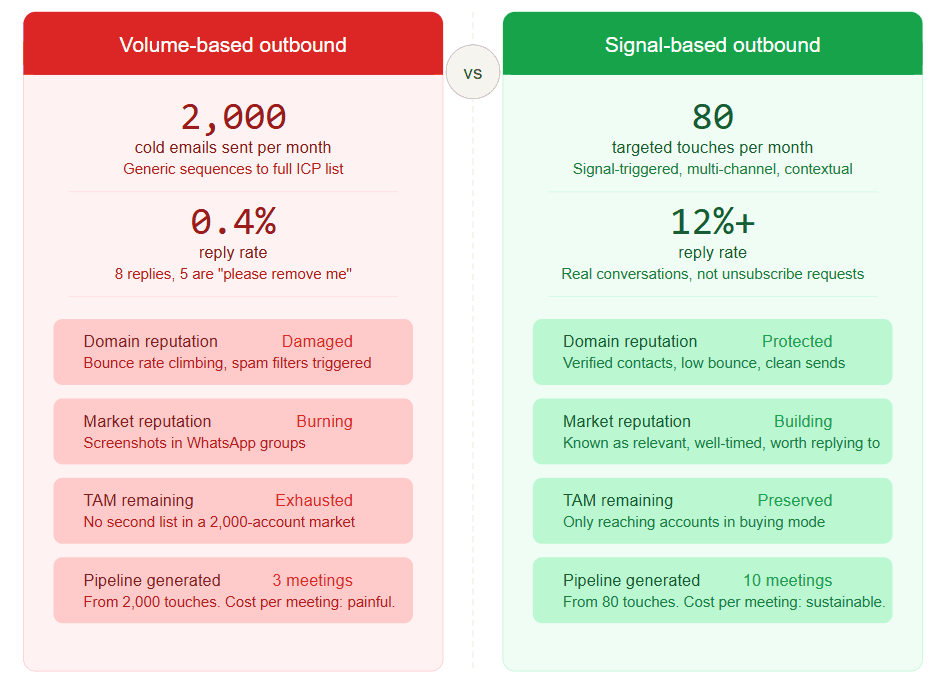
Same playbook. Different outcome.
Why does cold outbound keep failing (and why the GCC makes it brutal)?
Cold outbound is struggling everywhere. But in the GCC, it’s like cold outbound on steroids. Structural conditions make it fail faster, louder, and leave a scar that lasts.
1. Your emails aren't landing where you think they are
Most teams assume “sent” = “delivered.” But that’s not even close.
Your SDR sends 500 emails on Monday. CRM says 500 sent. Reality check:
- 40 bounced because contacts changed jobs
- 80 landed in spam thanks to last month’s campaign
- 120 went to catch-all inboxes that accept everything and read nothing
Your SDR thinks they reached 500 people. Truth? Maybe 260. And those 40 bounces just made next week worse.
In the GCC, this isn’t a minor hiccup. Your total market might be 2,000 accounts. Reach only half, torch your sender reputation, and your math collapses in months, not years.
2. Your data is rotting fast
B2B databases decay fast. People change jobs, companies pivot, and domains die. A list clean in January is already changed by March.
In GCC tech, where startups grow, pivot, and fold at lightning speed, decay happens faster. If you’re not verifying contacts every single campaign, you’re emailing ghosts.
Most global intent platforms barely cover the GCC. Funding rounds get reported late. Job postings don’t get indexed. Signals have holes.
Here’s a scenario for you: your target account just raised a round. Perfect signal. Your SDR grabs the CEO’s email that’s eight months old. It bounces. Domain reputation dips and next week’s campaign suffers.
Meanwhile, your competitor already booked the meeting.
Rule of thumb: verify contacts every campaign, not quarterly.
3. Your buyers already have a shortlist, and you’re not on it
Here’s where global outbound playbooks fail spectacularly in the GCC.
A Head of Product at a Riyadh SaaS startup is eyeing a new customer engagement platform. They don’t start with Google. Instead, they ask their LinkedIn network of regional product leaders: “Who’s using a tool to automate in-app notifications? Recommendations?”
Four peers reply. They browse one demo video, skim two blog posts, and download a whitepaper. By the time your system flags them as a “content download,” they’ve already narrowed their shortlist. That download is not early-stage curiosity but a final-stage check before they make a decision.
In the GCC, confirmation signals (website visits, LinkedIn likes, content consumption) matter more than in open markets. A website visit here screams: “Already decided to evaluate, now confirming.” Respond fast. Respond with specificity.
4. Your mistakes have names (and those names talk)
In the US, you cold-blast a list, learn, rinse, repeat. The market absorbs the errors invisibly.
Not in the GCC. Your mistakes have names. Those names are in WhatsApp groups with the people you need next quarter. A sloppy campaign doesn’t just hurt deliverability. It damages your brand in side talks that don't include you.
Mistakes here come back to find you.
Which buying signals actually matter for GCC tech companies?
Buying signals aren’t all created equal. Some scream “we’re ready to buy,” while others whisper “maybe someday.” In GCC tech, the stakes are high, and reading the signals correctly is everything.
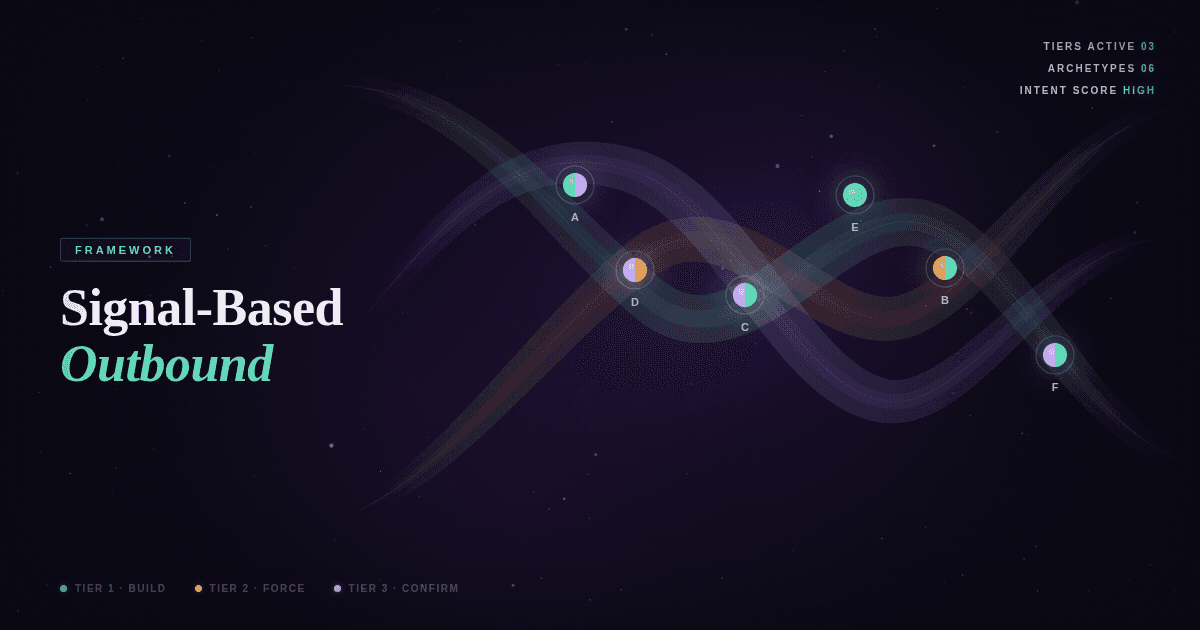
At Blue Pencil, we break signals into three tiers, not by how “hot” a lead feels, but by what the signal tells you about the company’s position. The real magic happens when signals stack together. We break this down fully, including how to stack signals into six actionable archetypes, in our signal-based outbound framework. Here’s how it looks for GCC tech companies.
Tier 1: Build signals (The company is actually investing)
These are the signs a company is putting money and energy into growth: hiring, adopting new tech, launching initiatives.
Example: A Dubai B2B SaaS company posts four SDR roles in the same week, hires a new Head of Revenue, and adds Outreach.io to their stack. They haven’t announced anything publicly. But your signal radar should be buzzing: this company is building an outbound engine this quarter.
Tier 2: Forcing functions (External events that demand action)
Funding rounds, M&A, office expansions into ADGM, DIFC, SAGIA, or a GCC-specific gem = government contract wins.
Example: A Riyadh SaaS company closes a $20M Series A. Within two weeks, the CEO is on deployment calls, and the VP of Sales is posting new roles. They’ve got money, pressure, and zero patience for slow vendors. Miss this window and six months later, the signal is worthless. So, act fast.
Tier 3: Confirmation signals (The company is actively looking at you)
These are the subtle signs that your prospect isn’t just browsing; they’re checking you out.
- Website visits (extra weight in the GCC because buyers research privately in WhatsApp groups before showing up publicly)
- LinkedIn engagement with your content
- Champion job changes, like a new CRO joining from a company that already loved your product
When these signals hit, it’s your cue to move.
When the stack lights up.
What makes running this system different in the GCC?
Signal-based outbound in the GCC isn’t just a “global playbook with a local accent.” You need three adjustments no North American or European guide will tell you:
1. Your buyers have already made up their mind before you see them
This is the single biggest difference between running outbound in the GCC and running it anywhere else.
Example: A VP of Marketing at a Dubai fintech needs a new outbound tool. Do they Google it? Nope. They text their WhatsApp group of 12 marketing leaders: “Anyone using a signal-based outbound tool? What’s good?” Three responses. They peek at two websites, skim one case study, glance at one pricing page. By the time your analytics sees them as a “website visitor,” they’ve already been pre-sold by three peers. That visit is late-stage validation.
This changes how you read every signal. In markets where buyers browse openly, a website visit might mean "just looking." In the GCC, it more likely means "already decided to evaluate, now confirming." A confirmation signal here is further down the buying process than the same signal in the US. Don’t treat these signals like a gentle nudge. Treat them like a green light. Act decisively, and make your outreach count.
2. Global data platforms have blind spots in MENA
Most signal detection tools were built for North America and Europe. In the GCC, coverage is patchy, funding rounds often appear late, etc.
Take a Saudi retail-tech company that closes a $45M Series B. Regional platforms pick it up in 48 hours. Global tools report it ten days later. By the time your system sees it, competitors have booked meetings. You’re left scrambling with stale data and missed opportunities.
The fix isn’t abandoning global tools; they still catch the big-picture signals. The real advantage comes from layering regional sources for funding, hiring, and government activity into your signal detection engine. That’s how you go from chasing leads to showing up first.
3. There's no second list
In a market with 50,000 target accounts, a bad campaign is just a learning experience. In a GCC market of 2,000 accounts, a bad campaign is a reputation disaster.
Every bounced email chips away at your sender score. Every spam complaint nudges you closer to getting filtered. And unlike big markets, the people you’re emailing talk to each other. A sloppy campaign doesn’t just hurt deliverability; it haunts your brand in conversations you’ll never hear about.
Here’s how it plays out. Your SDR sends a sequence to a retail-tech company in Abu Dhabi using an unverified contact list. Half the emails bounce. By the second day, your domain reputation takes a hit. Next week, a completely different sequence to a government-adjacent company sees lower deliverability. Meanwhile, competitors who verified their contacts first are already in meetings.
In the GCC, every email counts. There is no second chance.
What does a GCC signal-based outbound cadence look like?
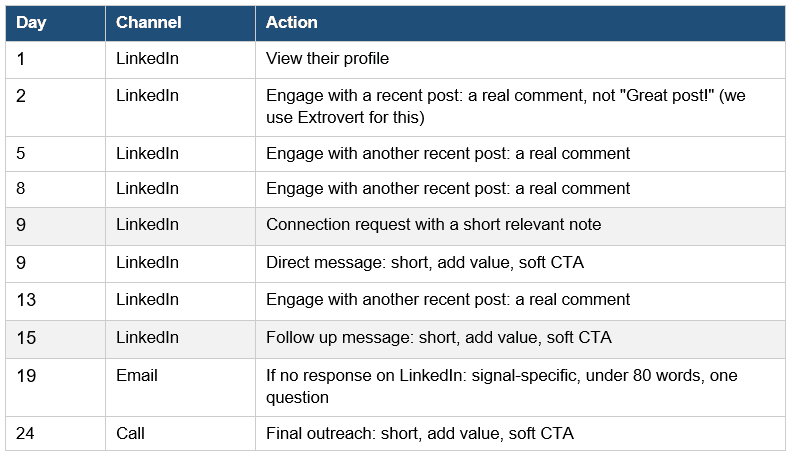
A GCC-ready cadence runs around 20 days across LinkedIn, email, and, where it makes sense, call. The trick is LinkedIn first (get seen, get noticed) and show up as a peer before your first email lands. In a market where relationships come first, this is the difference between “Who is this?” and “Oh, I’ve seen this person around.”
The rhythm is simple: LinkedIn first, email second, call only if there’s already a warm path.
Here’s why it works: comment on a couple of the prospect’s LinkedIn posts, send a connection request a day later, a LinkedIn message a few days later, then email if there's no response on LinkedIn. By then, the email feels like a natural follow-up, not a cold intrusion from a stranger. In the GCC, sequencing beats copywriting. Appear in the right order, and the conversation practically starts itself.
LinkedIn first. Email later. Call only when warm.
Messaging angles by signal type (these are angles, not templates. Adapt to your product):
- Build signal: "Looks like 4 open roles this month. When those new hires start, how will you handle [specific workflow]?"
- Forcing function: " If you're scaling go-to-market this quarter, we helped [similar company] during the same growth phase. Worth a 15-min look?"
- Confirmation signal (champion move): "When we worked with [similar role] at [similar company], the first thing they tackled was [relevant pain]. Happy to share what worked and what didn't as you ramp up your new role at [company]."
What are the most common mistakes GCC teams make?
We see the same mistakes over and over. Each one is fixable, but only if you catch it before the damage compounds.
1. Reacting to single signals instead of stacked combinations
A prospect likes your LinkedIn post and the SDR fires off a demo request 20 minutes later. That's not signal-based selling. It's being trigger-happy with a notification.
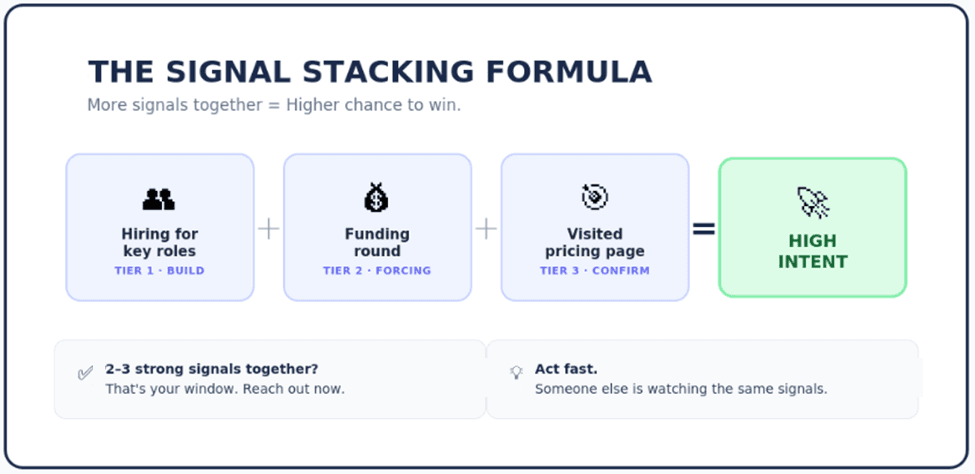
A LinkedIn like is a confirmation signal at best. Alone, it means almost nothing. Stack it with a build signal and a forcing function and you’ve got an entirely different story.
Discipline is in waiting. Don’t reach out every time a bell rings. Wait for the right combination.
Three signals lined up? That's your window.
2. Single-threading in a consensus-driven market
Three weeks of emailing the VP of Marketing = great engagement. Then radio silence. Two weeks later, you learn they left the company. Your pipeline item is vaporized.
GCC buying decisions often involve multiple stakeholders. Hierarchies matter and consensus matters. One resignation, and your deal resets.
Fix: map two to three contacts per target account across different roles. If one goes dark, you still have a conversation with the Director or Head of Ops.
3. Building the system before defining who it's for
You wire up signal detection, enrichment, and sequencing. Beautiful system. Then the alerts start, at companies that would never buy from you.
A fintech raises a round; your system flags it, but you sell to mid-market SaaS. Congratulations, you just wasted time on a lead that was never going to convert.
Rule of thumb: signals tell you when; ICP tells you who. You need both, and ICP always comes first.
How do you know it's working?
Signal-based outbound isn’t about how many emails you fire off. It’s about impact, timing, and results.
Track four things:
- Signal-to-meeting rate: What percentage of signal-triggered outreach converts to a meeting? Track by archetype so you know which combinations turn signals into pipeline gold.****
- Time-to-contact: How fast does your team act after a signal fires? For confirmation signals, same day. For forcing functions, within the week. Speed is where most teams lose the advantage they just built.****
- Pipeline per signal source: Which sources generate actual pipeline? This tells you where to double down and what to cut.****
- Cost per meeting: Total outbound spend divided by meetings booked. Compare to your cold outbound baseline. This is the number your CEO actually cares about.
What NOT to track: emails sent, connection requests, or meetings booked without attribution. If you can't trace the meeting back to a signal, you can't repeat what worked.
Final words: The timing advantage is still wide open
The GCC B2B market rewards precision and punishes laziness. The market is small. Reputation is everything. Buyers do their homework in private channels before they surface publicly.
A generic pitch is worse than showing up late. Show up at the exact right moment, with context that proves you’ve been paying attention, and you become the company that was already on the shortlist before the first meeting even started.
Most GCC tech companies haven't built this system. They're still running cold sequences on stale lists, losing pipeline to competitors who reach the right person two weeks earlier with a better reason. The companies that build this in the next six months will own the timing advantage in their category, because their competitors are still playing the volume game.
The playbook is here. The signals are firing. The only question is whether you build it now or keep sending the same LinkedIn pitch to everyone and hope something changes.

Shaimaa Badawi
Shaimaa Badawi is a Paid Media Specialist at Blue Pencil, helping companies in the GCC grow their sales pipeline through data-driven B2B strategies. She also writes practical, high-intent content that teaches teams how to identify the right prospects, optimize outreach, and generate meaningful results. Shaimaa has experience in content strategy and creating insights that help marketers and sales leaders close more deals with fewer wasted touches.